

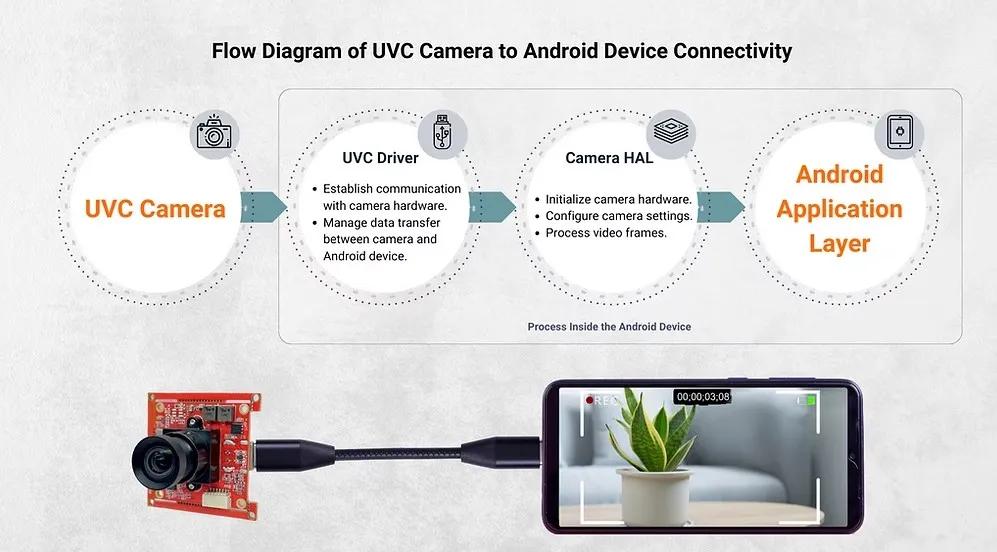
UVC Camera
A UVC camera has become a widely adopted solution in embedded vision, industrial automation, and machine vision applications. Built on the USB Video Class standard, these cameras offer plug-and-play functionality, making integration simple across multiple platforms without the need for complex drivers. Their flexibility and ease of use make them suitable for developers, system integrators, and businesses looking for reliable imaging solutions.
UVC cameras support real-time video streaming and are compatible with major operating systems such as Windows, Linux, and Android. This cross-platform compatibility allows faster deployment in projects ranging from robotics to medical imaging and surveillance systems.
Key Features of UVC Cameras
UVC cameras are designed to deliver performance along with simplicity. Some important features include:
Plug-and-Play Integration: No additional drivers required, reducing development time
High Compatibility: Works seamlessly with various software and hardware environments
Real-Time Processing: Enables fast image capture and transmission
Compact Design: Suitable for embedded systems with space constraints
These features make UVC cameras a preferred choice for applications that require efficiency and reliability.
Role of High Dynamic Range Camera
Lighting conditions often vary in real-world environments, which can impact image quality. A High Dynamic Range Camera helps capture clear images in both bright and low-light conditions. It balances exposure levels to ensure that details are visible in shadows as well as highlights.
When combined with UVC technology, HDR capabilities enhance overall imaging performance. This is especially useful in applications like traffic monitoring, industrial inspection, and security systems where lighting conditions are unpredictable.
High dynamic range ensures better contrast and improved clarity, allowing systems to detect and analyze objects more accurately.
Power over Ethernet Camera Integration
Another important advancement in imaging systems is the power over ethernet camera. These cameras use a single Ethernet cable for both power and data transmission, reducing the need for multiple connections.
In setups where long-distance connectivity is required, power over ethernet cameras offer a practical solution. They simplify installation and reduce infrastructure costs. While UVC cameras typically use USB interfaces, integrating PoE solutions in hybrid systems can provide additional flexibility for large-scale deployments.
Such configurations are useful in smart city projects, surveillance networks, and industrial automation environments where scalability is important.
Applications of UVC Cameras
UVC cameras are used across a wide range of industries due to their adaptability:
Industrial Automation: Quality inspection and defect detection
Medical Devices: Imaging and diagnostic systems
Retail and Security: Monitoring and analytics
Robotics: Vision-based navigation and object recognition
Embedded Systems: Integration in compact devices
Their ability to deliver consistent performance makes them suitable for both small-scale and enterprise-level applications.
Vadzoimaging – Advanced UVC Camera Solutions
Vadzoimaging provides high-quality UVC camera solutions designed for modern vision applications. With a focus on performance and innovation, Vadzoimaging offers cameras that integrate easily into existing systems while delivering reliable output.
The product range includes advanced imaging features such as HDR support, high-resolution sensors, and efficient data processing capabilities. Vadzoimaging solutions are built to meet the demands of industries that require precision and consistency.
Support for customization and technical expertise ensures that businesses can implement solutions tailored to their specific requirements.
Benefits of Choosing UVC Cameras
UVC cameras offer several advantages that make them a strong choice for imaging projects:
Easy integration with minimal setup time
Cost-effective solution for various applications
Reliable performance with consistent output
Compatibility with multiple platforms and devices
Flexibility to adapt to different environments
These benefits contribute to faster development cycles and improved system efficiency.
Conclusion
UVC cameras continue to play a significant role in modern imaging systems. With features like plug-and-play functionality, compatibility, and real-time performance, they provide a practical solution for diverse applications.
Combining UVC technology with High Dynamic Range Camera capabilities and power over ethernet camera integration enhances overall system performance. With solutions from Vadzoimaging, businesses can implement advanced imaging systems that deliver accuracy, efficiency, and scalability across multiple industries.